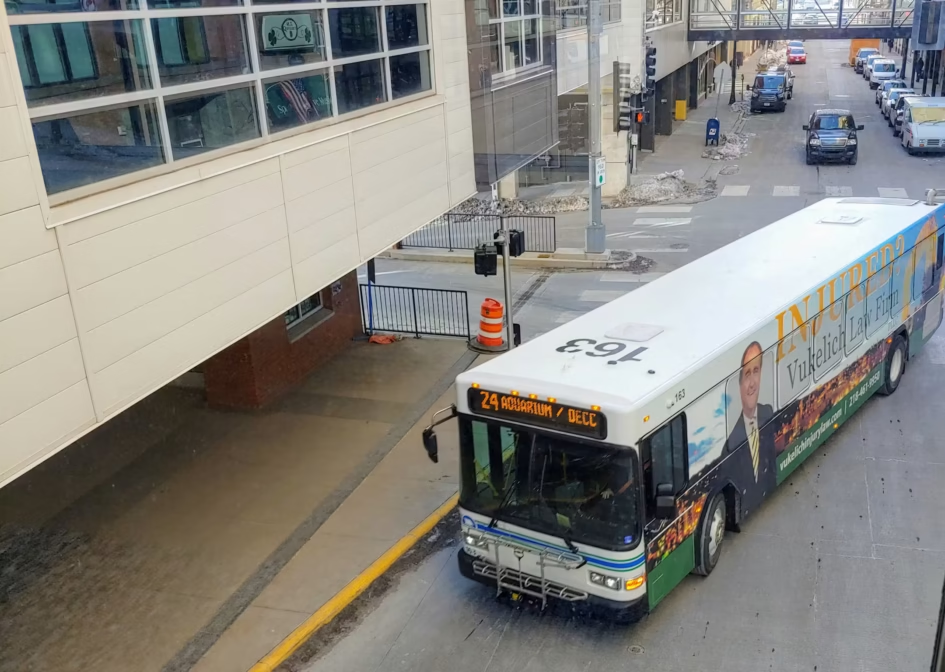
The obscured-from-view police substation undermines the very law enforcement presence other transit systems use to discourage disorder.
Robin Washington | The Minnesota Star Tribune | June 24, 2026
Somebody call the cops.
If that sounds like the setup for a clever punchline, it isn’t. It’s the Duluth Police Department’s advice to passengers who encounter troubling behavior when officers aren’t around at the Duluth Transportation Center.
“It’s an everyday thing,” said Jerry Ferguson of Duluth, waiting for a bus with his bicycle after 9 p.m. on a recent weeknight.
Ferguson was referring to a disturbance that had just happened in the women’s restroom. Linda Mitchell of the Twin Cities, in town via a bus for her granddaughter’s graduation, was attempting to use the facilities when she encountered a trio — including one man — whom she said were using illegal drugs.
“You’re standing there with a crack pipe!” Mitchell shouted to the group in the confrontation I caught on audio. “I got to go! I got to go!” she yelled, telling them to get out.
If men in the ladies room doing crack isn’t quite an everyday thing, as Ferguson claimed, it’s at least indicative of the deteriorating conditions at the transit center in recent months.
I’ve witnessed them myself as a frequent rider of both Jefferson Lines and Duluth Transit Authority (DTA) routes. Duluth Police Chief Mike Ceynowa confirmed it isn’t my imagination.
“We did have a significant increase towards the end of last year and the beginning of this year,” he said of calls for service at the transit center.
Opened in 2016, the Duluth Transportation Center is the hub for the DTA and connecting services such as Jefferson Lines. It relocated the DTA’s main transfer point from the front entrance of the Holiday Center hotel and retail complex on Superior Street to Michigan Street, a short block south and down a hill, with brakes complaining.
The move took transit riders off Duluth’s main drag and concentrated them in a facility built specifically for them. The least the city can do is make that facility feel safe.
The problem is apparently the people who aren’t riding a bus.
“Like many other locations around downtown, we are also feeling the impacts of the growing addiction and unhoused situation in our community,” DTA Executive Director Chris Belden said in an email.
In 2025, he said, the agency paid $141,093 to the Duluth Police Department for a dedicated police officer, $211,394 to a private security contractor and $179,697 for Transit Ambassadors, a program that was eliminated this year.
“That program was focused on cleaning, helping with passengers’ questions and needs, and low-level security,” Belden said. “We definitely felt the impact of that program’s discontinuation.”
The private security officers cover all the hours the facility is open, Belden said. (One did show up after the restroom incident began. But wherever he was beforehand — I was there and had been looking for exactly such a person and didn’t see one — did not prevent it from happening in the first place.)
Duluth police officers, Belden added, “have frequent coming and goings.”
Ceynowa echoed the societal challenges, identifying the issue as: “How do we effectively deal with people who either have severe and persistent mental illness, are chronically unhoused, or have substance use disorders?”
That’s a great question, but it’s not the one I asked, which is: What are they doing to keep the facility safe given that society has those problems?
Ceynowa noted that other cities face the same woes, which may be where he should start looking for an approach that works.
That includes the Twin Cities, where homelessness, mental illness and drug problems easily dwarf those of Duluth. Yet Metro Transit officials there aren’t trying to solve all of those issues when focusing on passengers’ fears of riding the system.
Rather, they’ve thrown everything at increasing the perception of safety, deploying highly visible transit and city police, private security personnel and Transit Rider Investment Program, or TRIP, agents. I saw them firsthand in a ride-along earlier this year, and witnessed similar increased visibility on my solo jaunts since then. It’s clearly made a difference in how the public perceives the system, one measure being that fewer are trying to ride the light rail system for free anymore.
So if increased visibility of authority works, is it something Duluth can do as well?
Ironically, the answer I see is already at the transit center: a Duluth police substation, right there for all would-be troublemakers to see. It’s an obvious deterrent — or would be, except it’s behind a one-way mirror, meaning the cops can see you but you can’t see them. So much for deterring a male crack user walking directly in front of the substation on the way to the ladies room.
Mitchell, whose incident happened 30 feet away, called the one-way glass “ridiculous.”
The obvious answer is regular see-through glass, but Ceynowa said police standards protecting the privacy of people brought in for questioning prohibit it. That may be, but I doubt they’re grilling suspects every hour of the day. And there is this invention called window shades.
All of this assumes they’re using the substation in the first place.
“Sometimes they’ll be there, sometimes not,” Ferguson said, offering his best guess.
So Ceynowa’s advice if you’re feeling uneasy and don’t see an officer around?
“One of the things that I have preached in this role is call 911,” he said, even if you’re unsure if the situation rises to the level of an emergency. The dispatchers will evaluate the circumstances and determine the appropriate response, he said.
Those dispatchers may have that down to a science, but it’s still reactive versus proactive. I don’t want a number to call to say I’ve just been hit on the head. I want police presence to discourage it.
Will that kind of deployment cost more than $141,093? Probably. But we’re only talking about one location, nary a drop in the bucket compared to whatever Metro Transit is shelling out after getting serious about safety.
Having a visible presence is also a lot cheaper than trying to solve homelessness, addiction or mental illness.
You don’t need a one-way glass to see that.

 WordPress