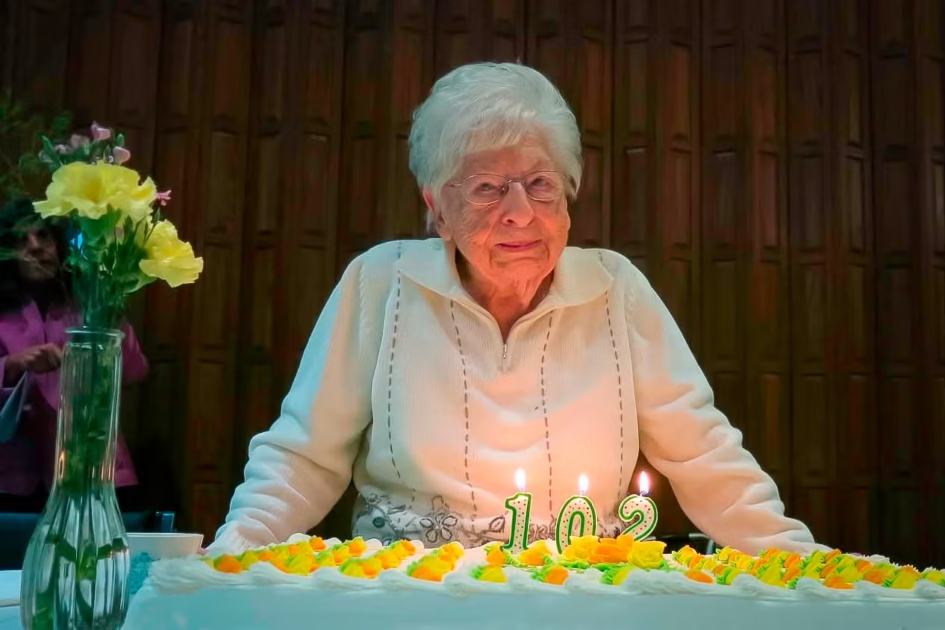
Born in Superior in 1917, Tusin recalled bustling Tower Avenue, discrimination against Jewish students, pioneering careers for women, and personal ties to Richard Bong and John Blatnik.
Robin Washington | Wisconsin Public Radio | July 21, 2026
One of Wisconsin’s oldest residents — almost certainly the oldest resident of Superior born in that city — has passed on. Isabell Tusin died last Tuesday at 108, or as the website gerontology.fandom.com counts it, 108 years and 246 days. During that time, she witnessed countless changes in the city and country, from Thursday night crowds on Tower Avenue to the hard-won opportunities for women that she lived through firsthand. She also knew the two men the Twin Ports’ bridges were named for: World War II flying ace Richard Bong and U.S. Rep. John Blatnik.
“Richard Bong was in study hall with me in high school,” Tusin recalled in a 2019 interview with WPR’s Robin Washington in celebration of her 102nd birthday. “He was very quiet — so quiet you wouldn’t know he was there. A nice guy, though.
“My father-in-law is the one that told John Blatnik to go into politics. He was a school teacher and my father-in-law said he would make a good legislator.”
Washington reprised their 2019 conversation for “Morning Edition” this week.
The following interview has been edited for brevity and clarity.
Robin Washington: Tell me about growing up in Superior.
Isabell Tusin: It was a nice, safe place to grow up. We had a lot of stores on Tower Avenue, and you could hardly walk Tower Avenue on Thursday nights, it was so crowded. Every block had a restaurant. You could get a cup of tea, a cup of coffee, anything you wanted. We had a lot of dress shops. We had a lot of men’s stores.
RW: That’s a little bit different than it is now.
Barry Tusin: Didn’t you guys deliver for the moonshiners during Prohibition?
IT: Not me! No, that was my cousin and her dad. My dad never did anything like that. He looked down on that. He thought it was terrible!
RW: Tell me about high school.
IT: What was interesting was Jewish kids could not join the sororities or fraternities.
RW: So you had sororities and fraternities in high school — but not for you.
IT: I could join clubs like the swimming club or other school clubs, but I couldn’t go into the sororities because Jewish kids weren’t allowed. And that was in public school.
RW: Where did you go to college?
IT: I went to Marquette University in Milwaukee for dental hygiene. When I got through, my dad said my education wasn’t complete, so then I went to business school.
RW: The other problem, as I understand, was there weren’t a whole bunch of people clamoring to hire you as a dental hygienist.
IT: At that time, most of your dentists were afraid at that time to hire a dental hygienist because they thought you were going to take their business from them. I couldn’t get a job in Duluth or Superior, but I got a job in Ashland from a dentist who was ahead of his time.
I started that, then I got called to Washington, D.C. I had taken the test for the federal government because my girlfriend was nervous to take it alone. I got called and she never did. So I quit and went to Washington, and took a job as a stenographer.
I transferred to Detroit but I didn’t particularly care for it. So I left that and went to Chicago until a fellow there said if I wanted to advance, I had to go away with him for a week. I told him where to go!
RW: That happened back then?
IT: Oh yeah! And you had nobody to run to. So I just packed my bag and went home.
RW: And then you worked at Oreck?
IT: Oreck’s was a beautiful department store in Duluth. I was there one week and they said they wanted to train me to be a supervisor. Then I met my husband and six weeks later we got married. So then I went to Chisholm.
We were there until Barry was two years old. And then we moved back to Superior because my dad talked my husband into working for him. He had a grocery store on the main street.
RW: What were some of the high points after you came back to Superior?
IT: There weren’t any high points! But my husband died young, so I got a job at the college, setting up extension programs.
RW: I know people ask you all the time: To what do you attribute your health and your well-being?
IT: Keeping busy. As long as you keep your mind going, you’re all right.
If you have an idea about something in northern Wisconsin you think we should talk about on Morning Edition, send it to us at northern@wpr.org.

 WordPress