Jean Birkenstein Washington
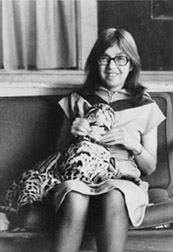
Jean Birkenstein Washington (1926–2003) — or simply Jean, as she was called by all who knew her, including her children — was an artist, a teacher and a leader in the Civil Rights Movement in 1950s and 1960s Chicago. Her home served as a safe house and community center for rival gangs, whose members were free to express themselves through art. Her work emphasized her belief that everything — human, animal or mineral — has its inherent self-worth, leading Jet magazine writer Alex Poinsett to describe her as “an artist with a profound respect for human dignity.”
A purposeful, driven, multi-faceted life
It is difficult to define Jean as one thing. While her art dominated her life — from childhood through her final years, crossing myriad genres along the way — many knew her primarily as an activist, planning and leading marches and sit-ins during the height of the Civil Rights Movement in Chicago.
Though those activities helped shape the city’s racial and political landscape for decades to come, others whose lives she touched were less aware of them, knowing Jean best as their teacher, tutor or mentor — someone determined to see you succeed, and who might take you to a college admissions office or an employer’s HR department to ensure your application received serious consideration.
To still others she was an insatiable intellectual force, determined to understand — and theorize about — the meaning, structure and interrelationship of all creation, on our planet and beyond. Even the briefest conversation could take you to worlds unexplored, both intellectually and concretely.
These pages attempt to display that interconnectedness, primarily through her art, interlaced with the countless causes and crusades she was simultaneously engaged in. How she found time to do so remains a mystery. Yet more than 20 years after her passing, her legacy continues to amaze virtually all who hear her story and serves as inspiration to many.
The Cat Series
Jean’s artistic output often manifested itself in series — subjects sometimes produced in succession but also revisited throughout her life. Each series frequently intermeshed with others, sometimes more than two at once. Paintings of cats were often drawn alongside members of her family — who themselves formed a series — or juxtaposed against landscapes and cityscapes.
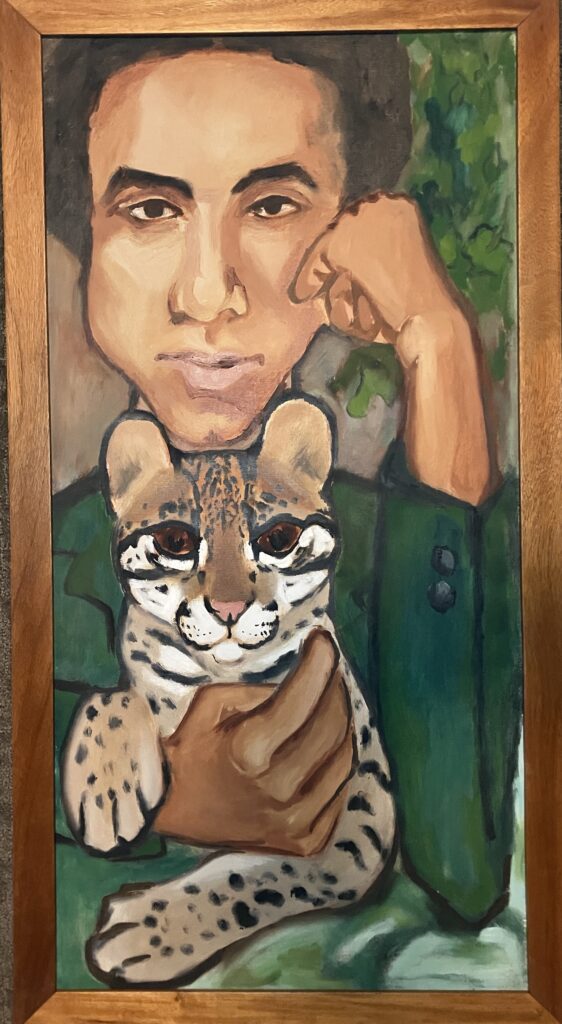
Oil on Canvas
1975
The Cat Series was her most prolific, beginning with a lion in her earliest known work as a middle schooler and continuing through the last year of her life.
While Jean was noted for her uncompromising respect for human dignity, she easily extended that belief to the animal world. (In accordance with her wishes, she is in fact buried in a pet cemetery.) Cats are the central figures in this work, even when humans appear alongside them; the world she captured is from their point of view.
The Family Series
It is common for artists to paint those closest to them. What further marks Jean’s subjects is that portraits that may at first seem to depict generic figures — “Man Reading a Newspaper,” for example — are almost always people she knew, even in crowd scenes.
Her family portraits — again, often accompanied by cats and other animals — chronicle the life cycles of those closest to her.
The Gang Series
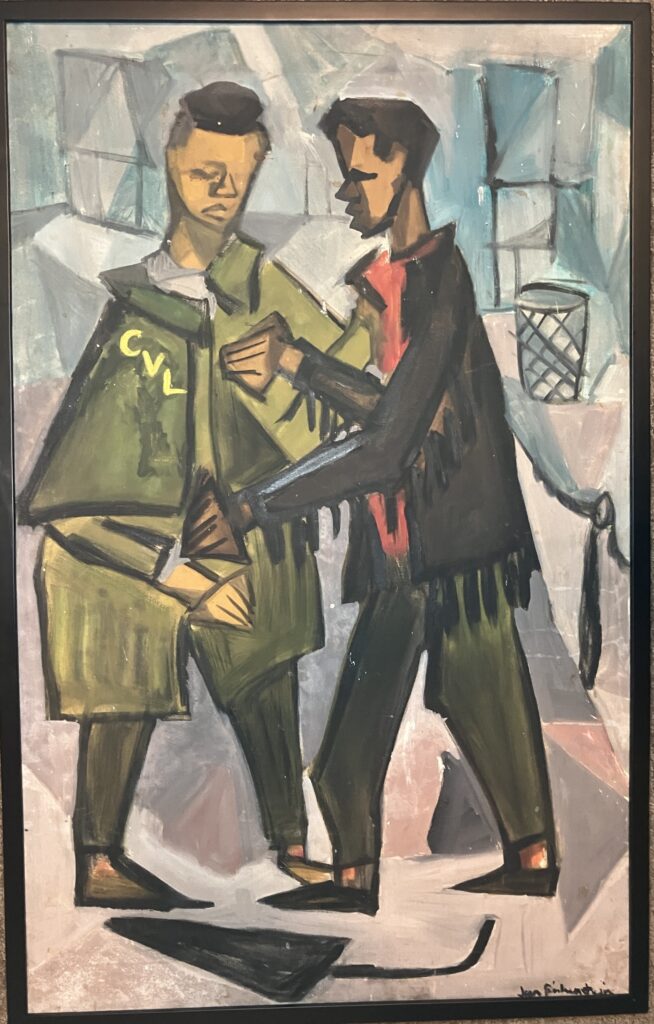
Oil on Canvas
Circa 1961
In an act that many Americans would find astounding today, while teaching at a Chicago high school of ever-changing racial composition, Jean became an ambassador to and between two of the city’s most notorious street gangs: the Vice Lords and their arch-rivals, the Cobras.
Respected as a confidante to the gangs, she would walk Vice Lords home through Cobra territory and vice versa. She also appeared at jails — sometimes just hours before beginning her day in the classroom — to bail out juveniles whom most others had given up on.
See the Jet magazine profile of Jean about her gang outreach
The impetus for their approach to her was word of her leadership in civil rights protests of the time, including a successful interracial “wade-in” at the city’s segregated Rainbow Beach
That relationship eventually led her to open her home to gang members — situated on the city’s Near North Side, neutral turf for the two sides — and to incorporate them into her art. Among her most powerful work, the series stands as a rare depiction of gang members as human beings, exploring both their lives and their artistic identity far beyond the more common association of graffiti.
The Slave Series
Jean’s marriage into an African American family in 1950 sparked a curiosity about her new surname. Stories from elders pointed to a Cherokee origin for “Washington” — either from a similar-sounding word or a translation meaning “washing place.”
That curiosity led Jean to survey other African Americans about Native ancestry.
Her inquiry, recorded on index cards, detailed frequent intermarriage between Blacks and Native Americans, as well as the enslavement of family members of both heritages. While in recent years this common oral tradition among Black families has often been dismissed as a myth — most notably by scholar Henry Louis Gates Jr. — Jean’s research took place in the 1950s, meaning the participants were describing grandparents they had personally known. There would be little reason for invention.
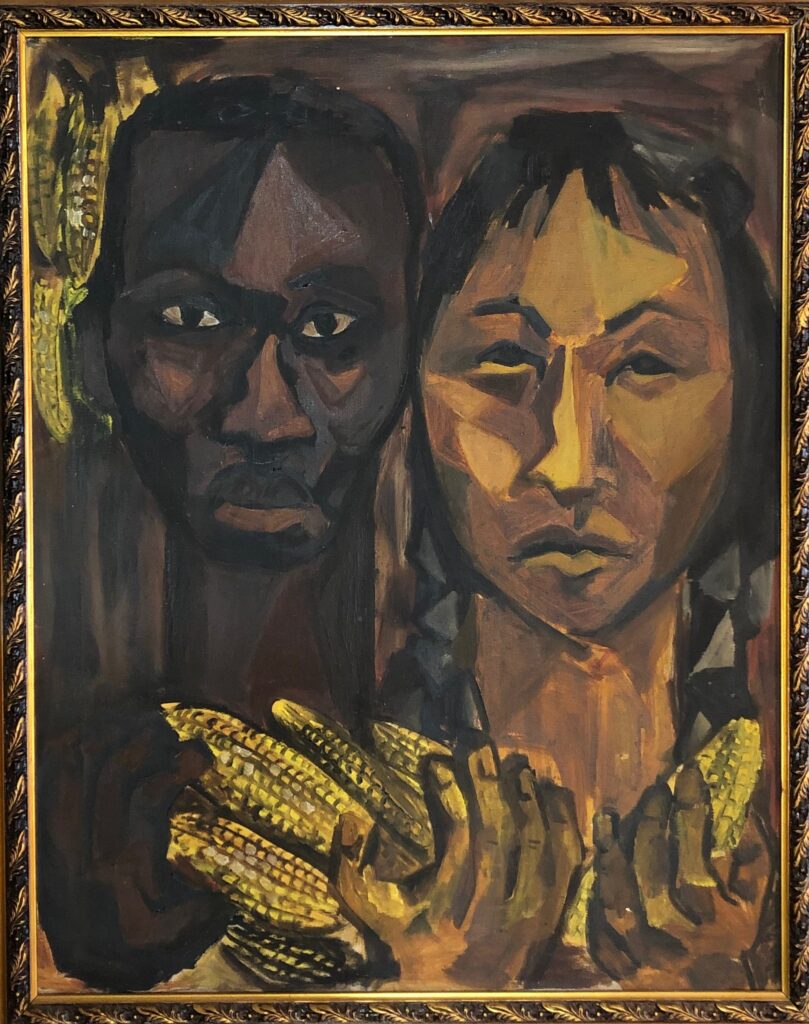
Oil on Canvas
Circa 1958
Indeed, a painting of that era depicting an African American and Native American couple identified after her death as “Carolyn Claybrook’s Grandparents” lays the foundation for genealogical exploration. Documentation of Carolyn Claybrook herself has yet to resurface, but will very likely emerge, as well as the validation of her description.
Across the Street
The home Jean and her husband purchased in 1953 — despite a restrictive covenant “barring the sale to negroes” (sic) — resulted in the interracial couple becoming the first Black family on the block.
The neighborhood’s complexion would change several times during her 35 years there, eventually leaving her as the last white person on the block (although she fiercely did not identify as such) before the cycle repeated, once again making the family among the first nonwhite residents there.
These demographic changes were not accidental but the result of a concerted campaign by the city’s powerful developers to capture prime real estate near Lake Michigan and downtown — adversaries she would spend half her life fighting.
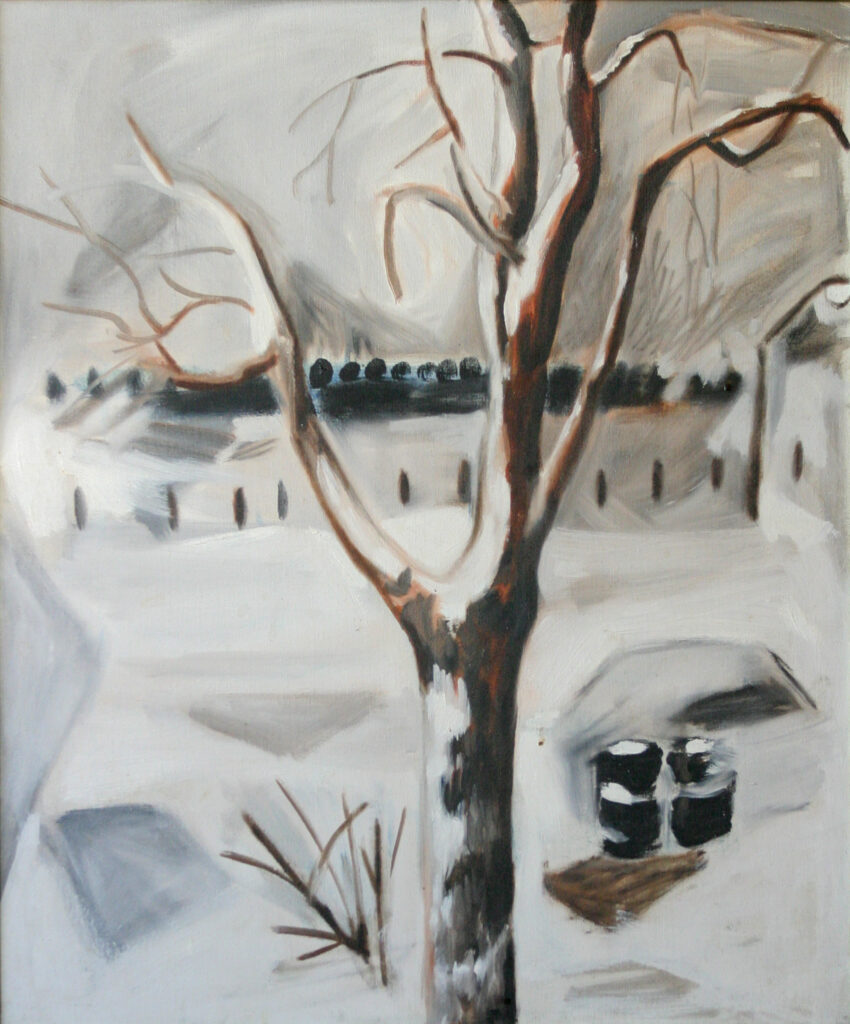
Oil on Canvas
1973
Throughout those years she documented both the changes and the stability around her, most vividly in 35 years of paintings of the El tracks across from her house. Set back from the street and allowing a sweeping view of the skyline in reverse, they form a visual chronicle of one of the city’s most iconic symbols.
Created in series sometimes spanning decades, Jean’s work reflected her unusual everyday life: the gang members mentioned above, depictions of 19th-century African American and American Indian couples as described by their grandchildren, and the Chicago El roaring past across the street from her home.
A portfolio of her artwork follows on the pages ahead. Also included are media stories touching on her eclectic and powerful life.
Spotlight on Artist, Teacher, Civil Rights Activist Jean Birkenstein Washington
Ed Newman, Nov. 14, 2019, on Duluth Art Institute Retrospective
“Why we buried our mom in a pet cemetery” A tribute to Jean by her son, Robin Washington, published in the July 26 Boston Herald and the July 27, 2003 Chicago Sun Times (Page 1)
Read more
“Her daughter Robin told the Chicago Sun-Times…” The story of Jean’s last wishes has been quoted – and misquoted – around the world. She would have gotten a laugh from this.
Read more
Jean was interred on Monday, July 7, 2003, at the Aarrowood Pet Cemetery in accordance with her wishes. Rabbi Capers Funnye presided. Aarrowood is at 24090 N Highway 45, Vernon Hills, Illinois, 1-1/2 mile northwest of the junction of Milwaukee Road & Half Day Road.
“Cats, Chicago, Vice Lords & Other Visions,” a retrospective exhibit was held spring 2005 at “The Playground” in Duluth, Minnesota.
Click here for photos and more information.

 WordPress